Can we afford it?
Tuesday 15 October 2024
FlyingOwning a plane
Flying is great fun, but it’s not a cheap hobby. Renting planes from a flying club is usually the best option to keep the cost under control. That is exactly what we have been doing for years.
But there’s a downside to that: the availability of the planes. And that is how we ended up with the idea of buying a plane. Before taking that step, let’s figure out if we can afford it.

So, how much does it cost?
The first thing that came to mind was to ask around. We know some plane owners that already know, right? Well, to our surprise, they either didn’t know, didn’t want to know or didn’t need to know. Most of them told us the same thing: reality never matches your calculations, so don’t bother trying to figure it out upfront.
They are probably right. Still, not trying does not feel like a good option either. We are not looking for an exact number, but we do want a realistic estimate.
Next step was an internet search for “how much does it cost to own a plane?”. Most of the information we found was from owners in the USA and does not match the reality over here in the Netherlands. And, as we already know, each make and model comes with its own quirks when it comes to cost.
Conclusion: we need to do our own homework. Luckily, I have already done quite a bit of related work over the last years for the flying club, which helps in understanding the different cost categories. Some numbers make a big difference; others hardly move the needle. Knowing that helps to focus on what matters and not waste time on nitty-gritty details.
Cost related to owning the plane
So, let’s get started. The first step is buying a plane and listing all costs related to owning it. This results in the yearly costs regardless of whether we actually fly the plane or not. If these numbers scare you: don’t buy a plane because it will only get worse when you keep reading
Purchasing the plane
The first big number is, of course, the amount of money to pay the seller. At this point in time, the KLM Flight Academy has put their Socata fleet up for sale, and their TB10’s may be a good match for what we are looking for.
Insurance
Although we have not yet agreed on actually buying a Socata TB10, it is useful to have a specific make and model in mind while doing the cost analysis. For example, it allows us to request insurance quotes for this particular type of plane.
We found that the insurance premiums are mainly driven to the (insured) value of the plane and the experience of the pilots who will fly it. The pilot with the least experience on type has a huge impact on the premium. The quoted premium show significant differences, so shopping around clearly makes sense.
Renting hangar space
There’s not a lot of hangar space available at our home base, Teuge (EHTE). We found two options: a commercial party offering a spot on a carousel or storing the plane in the flying club’s hangar.
The shared space of the flying club is much cheaper, but comes with an increased risk of damage, either caused by others or by us while moving planes around.
Other recurring costs
Next to storage and insurance costs, there are a few more annual costs for paperwork, software updates and so on. We used figures from the flying club to get some reasonable estimates.
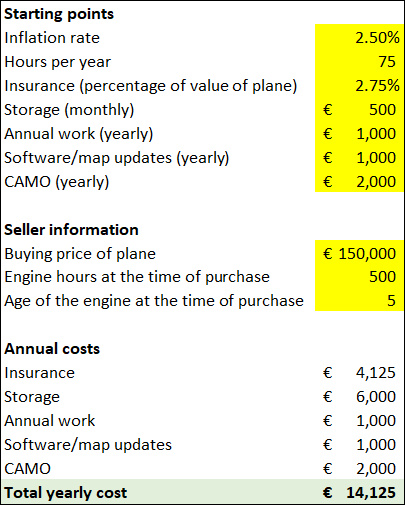
I put all this information into a spreadsheet for financial analysis. The sheet is set up in such a way that it is easy to create a version for any make or model we may consider. The values in the colored cells are input; all the other numbers are calculated. And this shows the yearly costs of owning the plane.
Cost related to using the plane
In the previous section, we looked at the costs of owning the plane. Let’s take a look at the costs of using it.
When talking about costs with plane owners, they all mention fuel and unexpected expenses related to unplanned repairs. Interestingly, none of them mentioned regular maintenance.
Every manufacturer documents a maintenance schedule to keep their planes airworthy. These schedules list checks at fixed hour intervals as well as inspections based on calendar time.
Each make and model has its own schedule, and we learned that regular maintenance for the TB10 that we use for reference is labor-intensive and therefore costly. Since this type of plane is no longer built, parts are also harder to find, which further increases costs.
We don’t want to contact actuals shops to discuss maintenance costs at this point in time, so we started with the information that the flying club has collected over the years, focusing on the three Cessna 172s in their fleet. These planes are all maintained by a commercial maintenance shop that ensures everything is done according to schedule.
The club’s historical data turned out to be extremely valuable in identifying what can be considered “normal” costs and what should be treated as exceptions.
Maintenance
Maintenance costs differ significantly between aircraft with petrol engines and those with diesel engines.
Both engine types have a defined “lifetime”, expressed in hours of operation and years of age. Once either limit is reached, the engine requires an overhaul (petrol) or replacement (diesel).
Petrol engines can be operated “on condition” beyond these limits. This means that, although the nominal lifetime has been reached, the maintenance shop closely monitors the engine and, as long as inspections don’t show concerning trends, it can continue to fly.
Diesel engines are different. End of life really means end of life, and you need to buy a new engine. This is somewhat debatable, as current documentation no longer explicitly states that replacement is mandatory. However, there is also no documentation from the engine manufacturer on how to access the condition of an engine beyond its lifetime. So, this is the risk of the owner(s). We decided that we are not willing to accept that risk, having seen many diesel engines fail even before reaching their maximum lifetime.
When buying a plane, it will probably come with an engine that has been used for a while. Based on that information, and our expected yearly flying hours, we can calculate when an overhaul or replacement will be needed and how much money should be set aside for that moment. The flying club’s data shows that replacing a diesel engine currently costs around 90.000 euro, while overhauling a petrol engine costs about 40.000 euro.
On top of these lifetime related costs, there are regular, hour-based maintenance intervals. Again, the club’s data shows major differences between petrol and diesel engines. Diesel engines require more frequent replacement of expensive parts. Combining all these costs allows us to calculate an “hourly maintenance costs” for both engine types.
These numbers are rough estimates. We have seen significant cost spikes over the years, and the figures can vary widely between different makes and models.
Fuel
There’s a lot of discussion about the use of leaded fuels in aviation, and this is directly tied to engine choice. To keep things short: in Europe, JetA1 (used by diesel engines) is widely available. I have not yet found an airport that sells automotive diesel to visitors.
Avgas (aviation gas/petrol), particularly 100LL, may become increasingly problematic. At the moment, there are two alternatives for 100LL: unleaded avgas (UL 91/94) or mogas (euro 98, as used in cars). The plane must be certified to use these fuels, and only a limited number of airports currently offer unleaded petrol; although I expect that to change as leaded fuels are phased out.
Historically, there’s been a large price gap between diesel and petrol in the Netherlands. We have noticed that this gap has become smaller over the last few years and is also much smaller in the surrounding countries.
We added running cost information to the spreadsheet.
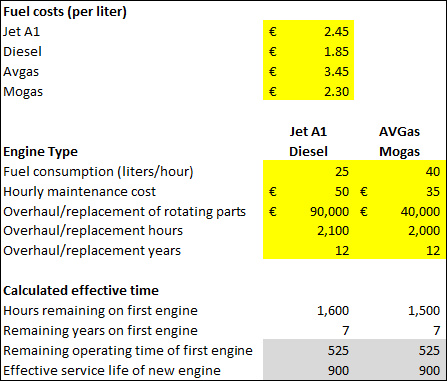
The spreadsheet can now calculate an hourly rate that covers operational costs and generate forecasts for the next 25 years. This is important given the impact of inflation on overhaul and engine replacement costs.
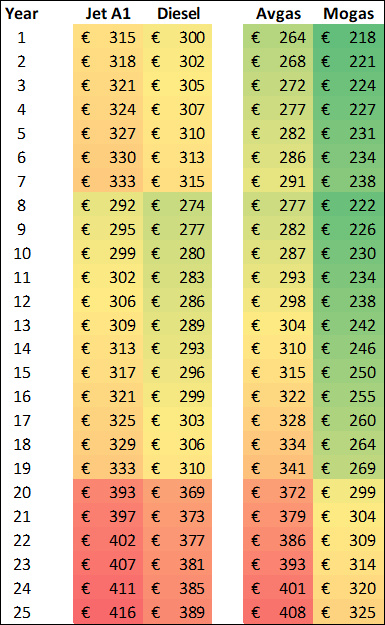
With our expected 75 flight hours per year, a diesel engine would only run for about 900 hours in 12 years, which is way less than 50% of its maximum lifetime. This is where the spreadsheet already proves its value: looking at all this information, it is clear that buying a plane with a diesel engine does not make sense for us.
Conclusion
The spreadsheet is a great way to understand where the money goes and what the financial risks really are. Based on the figures, I created an overview of several scenarios that apply to my personal situation.
In scenarios 1 and 2, I continue renting a plane from the flying club, with the difference being the number of flight hours per year. Scenarios 3 and 4 are based on owning a plane, differing in the type of fuel used.
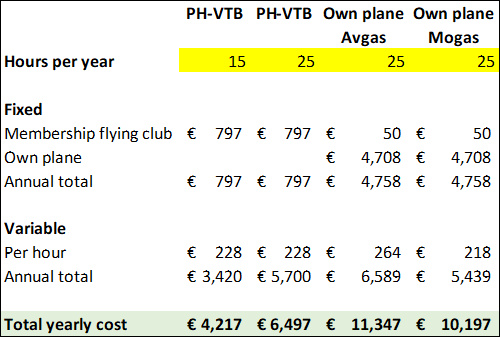
We started this journey with a simple question: what are the options to get more flexibility when it comes to having access to a plane? The answer is: buy one, and you can fly whenever you want. In our case, three private pilots flying purely for fun all need to feel comfortable with the numbers before taking the next step.
These figures may be rough estimates, but they make the financial discussion tangible. Some of us were surprised by the outcome and started asking a different question: am I willing to spend this much money on owning a plane? And if so: is it worth it?
We all need some time to process this…
Want to respond to this post?
Look me up on GitHub,
 Facebook or
 LinkedIn.
Tags
- 3D 9
- Air Safari 19
- Australia 67
- BlackBerry 1
- Blue Sky Flying Adventures 33
- By Boat 4
- By Bus 2
- Dev Containers 3
- Domoticz 2
- Driving 31
- Facebook 1
- Flying 39
- Gallery 2 7
- Google Maps 4
- Hugo 1
- Jekyll 4
- Linux 3
- NextGEN Gallery 5
- Owning a plane 3
- Podman 3
- Red Centre Tour 19
- Singapore 3
- Tasmania 10
- USA 33
- WSL 2 4
- Walking 42
- WordPress 17